
Sunlight
Radiance, brightness, vitality, and the illuminating power of the sun.
Olympian God · Sun, Music, Prophecy, and Healing
Apollo is the Greek god of the sun, music, prophecy, healing, poetry, and youthful brilliance. In Greek mythology, he represents light made intelligent: beauty, precision, talent, clarity, and the kind of power that shines outward through art, skill, and divine vision.
In the Percy Jackson world, Apollo is the godly parent behind Cabin 7 at Camp Half-Blood and one of the most recognizable Olympian identities for readers. This page connects Apollo's mythology, symbols, powers, Percy Jackson role, and Cabin 7 identity in one clear guide.
Quick Answer
Apollo is the Greek god of the sun, music, prophecy, healing, and archery.
He is one of the twelve Olympians and one of the brightest identities in Greek mythology.
In Percy Jackson, he is linked to Cabin 7 and is the father of Will Solace.
Apollo is the Greek god of the sun, music, prophecy, healing, poetry, and archery. He is one of the twelve Olympians and one of the most versatile and recognizable divine figures in Greek mythology.
In Percy Jackson, Apollo is the godly parent linked to Cabin 7 at Camp Half-Blood and the divine father of Will Solace. He is associated with talent, brightness, healing skill, confidence, and a high-energy form of power that blends charisma with real ability.
Jump to section
Overview
Apollo is one of the twelve Olympians and one of the broadest divine identities in Greek mythology. He governs the sun, music, prophecy, healing, poetry, and archery, which makes him a god of both beauty and precision. His power often feels bright, elevated, and skill-centered rather than dark or chaotic.
What makes Apollo especially distinctive is the way his domains connect. Light, truth, prediction, medicine, and artistic mastery all fit under his wider identity because Apollo represents clarity: the ability to reveal, heal, express, and strike accurately. He is a god of brilliance in more than one sense.
In Percy Jackson, that same identity carries directly into Cabin 7 at Camp Half-Blood. Apollo becomes more than a mythological sun god. He becomes a full demigod type built around talent, healing, confidence, brightness, and the ability to bring energy and skill into almost any situation.
Divine Domains
Apollo governs forms of power that illuminate, reveal, refine, and heal. His domains bring together beauty, knowledge, art, and precision in one of the richest Olympian identity systems.
Radiance, brightness, vitality, and the illuminating power of the sun.
Lyric art, performance, harmony, and expressive creative excellence.
Divine foresight, truth, sacred interpretation, and clear vision beyond the present.
Medicine, recovery, balance, and the restoration of physical well-being.
Language shaped into beauty, pattern, memory, and artistic meaning.
Precision, focus, range, and skill that strikes exactly where intended.
Powers and Abilities
Apollo's power is flexible, radiant, and highly skilled. He is not a one-note god. Instead, he represents excellence across multiple forms of influence, from healing and prophecy to performance and targeted force.
Apollo is associated with light, vitality, beauty, and the power to illuminate what was hidden.
He governs prophecy and divine foresight, especially through sacred interpretation and future knowledge.
Apollo is strongly tied to medicine, recovery, and the restoration of order in the body.
He represents mastery in music, poetry, and performance, where talent becomes a form of divine influence.
Through archery, Apollo symbolizes focus, range, and exact skill rather than brute-force combat.
Greek Myth vs Percy Jackson
Percy Jackson
In Percy Jackson, Apollo stands out because he brings a different kind of Olympian energy to the world. He is not defined mainly by kingship like Zeus, shadow like Hades, or cold strategy like Athena. Instead, Apollo feels bright, performative, fast-moving, and unusually broad in what he represents.
That breadth is a big reason he matters so much to readers. Apollo touches healing, prophecy, archery, music, and confidence all at once, which makes his identity especially easy to connect with. He feels like an Olympian whose power is visible in personality, talent, and presence as much as in mythic status.
For Percy Jackson fans, Apollo becomes especially important through Cabin 7 and through Will Solace. Together, they turn Apollo from a mythological sun god into one of the clearest Camp Half-Blood identity paths for readers who value brightness, competence, and expressive strength.
Camp Half-Blood
Cabin 7 is one of the most recognizable cabins at Camp Half-Blood because it combines multiple high-interest identities in one place: healing, music, prophecy, archery, and bright social energy. Apollo's children are associated with talent, charisma, responsiveness, and the ability to bring both skill and vitality into tense situations.
For readers, Cabin 7 often appeals to people who want strength to feel expressive, flexible, and alive. It is one of the strongest comparison cabins when users are deciding between Apollo, Athena, Poseidon, and Hermes.
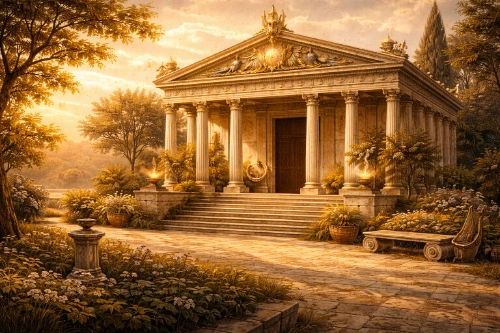
Cabin 7 blends healing, precision, and radiant creative strength in the Camp Half-Blood system.
Family
Notable Children and Related Figures
The main Apollo-line anchor in Percy Jackson. Will embodies healing, brightness, steadiness, and the practical competence that makes Cabin 7 so memorable.
An Apollo camper who helps reinforce the musical and performance-oriented side of Cabin 7's identity.
A famous healing figure associated with Apollo, reinforcing his connection to medicine and restorative divine knowledge.
Though not Apollo's child in the standard sense, Orpheus is closely tied to Apollo's artistic world through music, beauty, and sacred expression.
Mythology
Apollo's connection to Delphi makes him the central god of prophecy, sacred truth, and divine interpretation in Greek mythology.
The story of Daphne is one of Apollo's most famous myths and helps explain the laurel's place among his sacred symbols.
This myth highlights Apollo's connection to musical mastery, artistic rivalry, and the dangerous edge of divine excellence.
Apollo's connection to Asclepius reinforces his role as a god of healing, medicine, and life-restoring knowledge.
Apollo's bond with Artemis helps define him within the Olympian family as a twin god of brilliance, youth, and sacred identity.
Personality Match
Apollo-identified readers usually connect with brightness, talent, confidence, responsiveness, and the desire to express skill clearly. This profile often appeals to people who want power to feel alive, visible, and useful in the moment.
Compared with more inward or heavily structured godly-parent identities, Apollo feels quicker, warmer, and more openly expressive. His energy is often tied to competence that shows itself through movement, performance, healing, or intuitive precision.
This profile frequently appeals to readers who value creativity, charisma, optimism, and a high-functioning kind of versatility.
Apollo vs Athena: Apollo is more expressive, performative, and fluid, while Athena is more structured, strategic, and systems-focused.
Apollo vs Poseidon: Apollo feels brighter, more social, and more visibly energetic, while Poseidon feels deeper, steadier, and more instinctive.
Apollo vs Hades: Apollo is outward, radiant, and high-visibility, while Hades is private, intense, and shadow-centered.
Appearances
Apollo helps establish the Olympian world as a place shaped by strong, distinct godly identities, even when he is not the central conflict.
Apollo's presence continues through the larger Olympian background and through the identity logic that supports Cabin 7.
As divine tensions increase, Apollo remains part of the larger Olympian framework around prophecy, identity, and power.
Apollo's domains of prophecy, talent, and directional skill remain relevant to the deeper mythic logic of the series.
Apollo matters as part of the Olympian defense of Olympus, while Cabin 7 continues to represent healing, precision, and bright capability within Camp Half-Blood.
Why Apollo Matters
Apollo matters in Greek mythology because he represents one of the most complete forms of divine excellence: beauty joined to precision, art joined to truth, and healing joined to prophecy. He is a god of illumination in both the literal and symbolic sense.
In Percy Jackson, Apollo matters as a godly-parent archetype, Cabin 7 identity anchor, and one of the easiest Olympian paths for readers to imagine themselves inside. He turns radiant mythology into a vivid, personal identity built around talent, healing, and bright power.
Discover your godly parent
If you connect with talent, healing, creativity, brightness, and fast, expressive competence, Apollo may be one of your strongest Camp Half-Blood matches.
Apollo Cabin 7 Guide
Explore Cabin 7 traits, healing powers, Will Solace's legacy, and what it means to belong to Apollo at Camp Half-Blood.
Read Guide
Will Solace Profile
See why Will is the clearest Apollo-line anchor and how he defines Cabin 7 for Percy Jackson readers.
Read Guide
Percy Jackson Cabin Quiz
Find out whether Apollo is your strongest godly-parent match at Camp Half-Blood.
Read Guide
12 Olympian Gods Guide
Compare Apollo with Athena, Poseidon, Zeus, and the rest of the Olympian gods in one overview.
Read Guide


