
Sea
Oceans, coasts, tides, maritime power, and the unpredictable force of open water.
Olympian God · Sea, Earthquakes, and Horses
Poseidon is the Greek god of the sea, earthquakes, horses, and deep natural force. In Greek mythology, he represents power that is vast, emotional, and difficult to control, from crashing storms and shifting coastlines to the hidden pressure beneath the earth itself.
In the Percy Jackson world, Poseidon is the divine father of Percy Jackson and the godly parent behind Cabin 3 at Camp Half-Blood. This page connects Poseidon's mythology, symbols, powers, Percy Jackson role, and Cabin 3 identity in one clear guide.
Quick Answer
Poseidon is the Greek god of the sea, earthquakes, and horses.
He is one of the twelve Olympians and one of the most powerful gods in Greek mythology.
In Percy Jackson, he is Percy Jackson's father and the godly parent of Cabin 3.
Poseidon is the Greek god of the sea, earthquakes, storms, and horses. He is one of the twelve Olympians and one of the most powerful gods in Greek mythology, associated with overwhelming force, distance, and deep emotional intensity.
In Percy Jackson, Poseidon is the father of Percy Jackson and the god linked to Cabin 3 at Camp Half-Blood. He is associated with loyalty, instinct, resilience, sea-born power, and a quieter kind of authority than Zeus.
Jump to section
Overview
Poseidon is one of the twelve Olympians and one of the most recognizable gods in Greek mythology. He rules the sea, commands storms, causes earthquakes, and is linked to horses and the wild energy of motion. His power feels broad, elemental, and difficult to contain, which makes him one of the most dramatic divine figures in the Greek world.
Unlike Zeus, who often represents visible authority and kingship, Poseidon represents force that moves underneath and around structures. He is tied to depth rather than height, instinct rather than law, and sudden upheaval rather than orderly control. That identity makes him powerful in a different way: less political, more elemental, and often more emotionally charged.
In Percy Jackson, that same identity carries directly into Percy himself and into Cabin 3 at Camp Half-Blood. Poseidon becomes more than a mythological sea god. He becomes an entire demigod type built around loyalty, resilience, intuition, and calm strength under pressure.
Divine Domains
Poseidon governs power that moves in waves, breaks boundaries, and reshapes the world through pressure. His domains are physical, emotional, and elemental at the same time.
Oceans, coasts, tides, maritime power, and the unpredictable force of open water.
Ground-shaking upheaval, rupture, instability, and sudden destructive force.
Sea storms, harsh weather, and the violence of nature under pressure.
Speed, motion, nobility, and wild animal power linked to Poseidon's ancient symbolism.
The mysterious, hidden, and emotionally deep spaces beneath the surface.
The kind of power that does not need ceremony or status to be overwhelming.
Powers and Abilities
Poseidon's power is elemental, physical, and expansive. He is less associated with abstract law or political rule than with direct command over some of the most dangerous and powerful forces in the natural world.
Poseidon governs oceans, waves, tides, currents, and the wider force of the sea.
He can shake the ground and is traditionally known as the Earth-Shaker.
Poseidon is associated with sea storms, violent weather, and destructive maritime force.
He has a deep symbolic connection to horses and other sea-linked creatures, especially those tied to movement and power.
Poseidon represents ancient force that can feel calm one moment and catastrophic the next.
Greek Myth vs Percy Jackson
Percy Jackson
In Percy Jackson, Poseidon is one of the most important Olympians because he is Percy's father and because his identity shapes so much of the series' emotional center. He is not just a god in the background. He is part of the reason Percy matters, part of the reason divine politics become dangerous, and part of the reason Cabin 3 carries so much symbolic weight.
Poseidon also stands at the center of one of the clearest Olympian tensions in the series: his conflict with Zeus. In The Lightning Thief, that tension raises the stakes immediately. Percy is not simply a random demigod on a quest. He is the son of one of the most powerful gods, caught inside a crisis that could become a war between Olympus and the sea.
For readers, Poseidon works because he combines mythic power with emotional resonance. Through Percy, Poseidon becomes associated not only with storms and oceans, but with loyalty, distance, inheritance, and strength that stays steady even when the world becomes unstable.
Camp Half-Blood
Cabin 3 is one of the most iconic cabins at Camp Half-Blood because it is directly tied to Percy Jackson and to one of the strongest elemental identities in the series. Poseidon's children are associated with instinct, loyalty, emotional depth, sea-born strength, and resilience under pressure.
For readers, Cabin 3 often appeals to people who see power as something steady, deep, and natural rather than flashy. It is one of the strongest comparison cabins when users are deciding between Poseidon, Zeus, Athena, Apollo, and Hades.
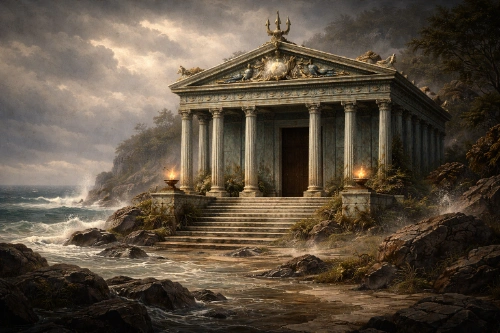
Cabin 3 reflects sea-born instinct, emotional depth, and resilient force in the Camp Half-Blood system.
Family
Notable Children and Related Figures
The main Poseidon-line anchor in Percy Jackson. Percy embodies sea-born power, loyalty, endurance, instinct, and calm strength in crisis.
Percy's Cyclops half-brother reinforces Poseidon's wider mythic line and the sea god's connection to unusual but powerful family structures in Riordan's world.
A famous hero often linked to Poseidon in myth traditions, reinforcing the god's role in heroic lineage and divine ancestry.
Poseidon's son and a major sea-linked figure who expands Poseidon's identity beyond Olympus into the wider marine world.
Mythology
Poseidon and Athena compete to become the patron of Athens, a myth that defines Poseidon as powerful, dramatic, and tied to force rather than civic practicality.
Poseidon's anger toward Odysseus after the blinding of Polyphemus makes him one of the main divine obstacles in the Odyssey.
Ancient traditions connect Poseidon to the creation or gifting of the horse, reinforcing his link to movement, nobility, and raw animal force.
Theseus is often tied to Poseidon as a divine father figure, connecting Poseidon to heroic lineage and royal identity.
Poseidon helps build the walls of Troy in one tradition, showing his connection not only to destruction, but also to monumental force and labor.
Personality Match
Poseidon-identified readers usually connect with depth, instinct, resilience, loyalty, and strength that does not always need to be announced. This profile often appeals to people who feel powerful in a steady, natural, and emotionally grounded way rather than through overt dominance.
Compared with more obviously strategic or status-driven godly-parent identities, Poseidon feels more intuitive and elemental. His energy is often linked to deep feeling, endurance, and pressure that builds below the surface before showing itself clearly.
This profile frequently appeals to readers who want strength to feel real, protective, emotionally alive, and capable of becoming overwhelming when necessary.
Poseidon vs Apollo: Poseidon feels deeper, heavier, and more instinctive, while Apollo is brighter, faster-moving, and more expressive.
Poseidon vs Zeus: Poseidon represents force, depth, and sea-born instinct, while Zeus is more openly commanding, hierarchical, and authority-driven.
Poseidon vs Hades: Poseidon is more fluid, emotionally forceful, and outwardly elemental, while Hades feels quieter, more guarded, and shadow-centered.
Appearances
Poseidon is central to the book's main conflict because the theft of Zeus's master bolt threatens war between Olympus and the sea god's line.
Poseidon's world and symbolism become even more vivid through the sea-centered setting and Percy's growing understanding of his own identity.
Poseidon remains an important background force through Olympian politics and Percy's continued role as his son.
Poseidon's identity continues to shape Percy as larger prophecies, loyalties, and pressures deepen.
Poseidon's power and loyalty matter directly to the fate of Olympus, reinforcing his importance as both divine force and father.
Why Poseidon Matters
Poseidon matters in Greek mythology because he represents one of the oldest and most overwhelming forms of divine power: the sea, the storm, and the unstable force beneath the world's surface. He is a god of scale, distance, pressure, and disruption.
In Percy Jackson, Poseidon matters as a godly-parent archetype, Cabin 3 identity anchor, and emotional center of one of the series' strongest demigod lineages. He turns elemental mythology into something personal, inherited, and immediately meaningful to readers.
Discover your godly parent
If you connect with instinct, loyalty, emotional depth, sea symbolism, and calm strength under pressure, Poseidon may be one of your strongest Camp Half-Blood matches.
Poseidon Cabin 3 Guide
Explore Cabin 3 traits, sea powers, Percy's legacy, and what it means to belong to Poseidon at Camp Half-Blood.
Read Guide
Percy Jackson Profile
See why Percy is the clearest Poseidon-line anchor and how he defines Cabin 3 so strongly.
Read Guide
Percy Jackson Cabin Quiz
Find out whether Poseidon is your strongest godly-parent match at Camp Half-Blood.
Read Guide
12 Olympian Gods Guide
Compare Poseidon with Zeus, Athena, Apollo, and the rest of the Olympian gods in one overview.
Read Guide


