
Fire
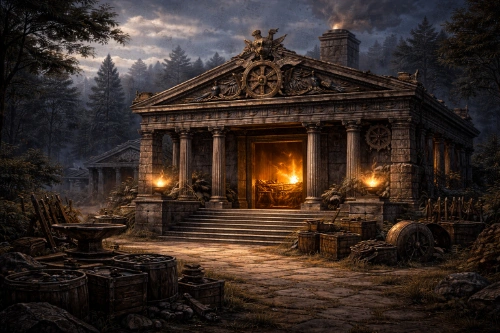
Forge fire, controlled heat, and the transformative power that reshapes raw material.
Olympian God · Fire, Metalwork, and Invention
Hephaestus is the Greek god of fire, metalwork, invention, craftsmanship, and the forge. In Greek mythology, he represents intelligence expressed through making: tools, structure, labor, design, and the kind of power that turns raw material into something durable and useful.
In the Percy Jackson world, Hephaestus is the godly parent behind Cabin 9 at Camp Half-Blood and one of the clearest builder identities in the series. This page connects Hephaestus's mythology, symbols, powers, Percy Jackson role, and Cabin 9 identity in one clear guide.
Quick Answer
Hephaestus is the Greek god of fire, metalwork, and invention.
He is one of the twelve Olympians and a major symbol of craftsmanship and design.
In Percy Jackson, he is linked to Cabin 9 and is the father of Leo Valdez.
Hephaestus is the Greek god of fire, metalwork, invention, blacksmithing, and skilled craftsmanship. He is one of the twelve Olympians and one of the clearest symbols of practical intelligence and creation through labor in Greek mythology.
In Percy Jackson, Hephaestus is the godly parent linked to Cabin 9 at Camp Half-Blood and the divine father of Leo Valdez. He is associated with invention, engineering, persistence, systems thinking, and the ability to build solutions under pressure.
Jump to section
Overview
Hephaestus is one of the twelve Olympians and the divine craftsman of Greek mythology. He rules the forge, metalwork, invention, fire, and the skill required to build objects that are both functional and extraordinary. His power is not based on beauty, kingship, or battle command, but on making things that last.
That makes Hephaestus one of the most distinctive Olympians. He represents intelligence expressed through work: design, repair, engineering, and technical mastery. In myth, he creates armor, weapons, thrones, automatons, and divine tools, which gives him a different kind of authority from gods who rule through force or status.
In Percy Jackson, that same identity carries directly into Cabin 9 at Camp Half-Blood. Hephaestus becomes more than a mythological forge god. He becomes a full demigod type built around invention, persistence, problem-solving, and the ability to turn pressure into construction rather than collapse.
Divine Domains
Hephaestus governs power that is built, shaped, repaired, and engineered. His domains center on creation through skill rather than through inheritance, charisma, or brute force.
Forge fire, controlled heat, and the transformative power that reshapes raw material.
Smithing, forging, armor-making, weapons, and divine crafted objects.
Engineering, mechanisms, technical solutions, and design that solves real problems.
Precision, labor, patience, and mastery expressed through skilled making.
Constructed systems, mechanical intelligence, and mythic devices built by design.
Persistence through difficulty, repeated effort, and the discipline required to finish difficult work.
Powers and Abilities
Hephaestus's power is constructive, technical, and materially transformative. He does not dominate through spectacle alone. He changes the world by making things other gods depend on.
Hephaestus governs fire and metalwork at the highest divine level, shaping extraordinary objects from raw materials.
He represents mechanical intelligence, systems design, and the ability to build solutions where others only see obstacles.
His creations can carry immense divine force, from armor and weapons to automated servants and traps.
Hephaestus symbolizes careful execution, useful design, and problem-solving through construction rather than guesswork.
He is associated with labor, persistence, and the ability to keep working until a difficult thing functions properly.
Greek Myth vs Percy Jackson
Percy Jackson
In Percy Jackson, Hephaestus matters because he brings a very specific kind of power into the camp system: intelligence that builds. He is not mainly associated with prophecy, kingship, or glamour. Instead, he represents engineering, practical skill, and the ability to make machines, tools, and structures work under pressure.
That identity becomes especially vivid through Leo Valdez and Cabin 9. Hephaestus's line shows that problem-solving is not always quiet or purely theoretical. Sometimes it is noisy, mechanical, inventive, and tied to fire, tools, and rapid improvisation.
For readers, Hephaestus becomes meaningful because he broadens the definition of strength inside Camp Half-Blood. He represents one of the clearest cases where building, fixing, and designing are not side skills, but central heroic powers.
Camp Half-Blood
Cabin 9 is one of the most distinctive cabins at Camp Half-Blood because it is built around invention, machinery, and practical making. Hephaestus's children are associated with engineering, technical skill, repair, mechanical creativity, and the kind of intelligence that turns ideas into working systems.
For readers, Cabin 9 often appeals to people who see strength in building, solving, fixing, and creating under pressure. It is one of the strongest comparison cabins when users are deciding between Hephaestus, Athena, Apollo, and Hermes.
Family
Notable Children and Related Figures
The main Hephaestus-line anchor in Percy Jackson. Leo embodies invention, fire, humor, engineering talent, and the restless builder energy of Cabin 9.
A memorable Hephaestus camper whose craftsmanship, loyalty, and practical courage help define Cabin 9 for many readers.
A famous crafted figure associated with Hephaestus's wider mythic identity, reinforcing his link to constructed power and mechanical design.
In some myth traditions, Pandora is shaped through divine craft, connecting Hephaestus to creation through making rather than birth.
Mythology
Hephaestus is famous for crafting armor, tools, and weapons for gods and heroes, showing that his labor underpins much of mythic power.
The story of the trapped throne reflects his technical brilliance and his ability to use invention as leverage and revenge.
His marriage to Aphrodite adds complexity to his identity, contrasting labor and craft with beauty, desire, and emotional tension.
Traditions connecting Hephaestus to crafted beings like Talos reinforce his association with automation and mechanical intelligence.
Myth traditions around his birth and rejection add emotional depth to his image and contribute to his identity as an outsider who creates indispensable things.
Personality Match
Hephaestus-identified readers usually connect with making, fixing, designing, and working through difficult problems until something finally functions. This profile often appeals to people who trust skill, craft, and persistence more than flashy presentation.
Compared with more socially visible or emotionally expressive godly-parent identities, Hephaestus feels grounded, practical, and tool-oriented. His energy is often tied to technical thinking, stubborn endurance, and the satisfaction of building something real.
This profile frequently appeals to readers who want power to feel useful, engineered, hands-on, and earned through work.
Hephaestus vs Apollo: Hephaestus is more hands-on, mechanical, and tool-driven, while Apollo feels brighter, more expressive, and more talent-centered.
Hephaestus vs Athena: Hephaestus represents building through labor and engineering, while Athena is more strategy-driven, architectural, and mentally structured.
Hephaestus vs Hermes: Hephaestus is steadier, more technical, and more construction-focused, while Hermes feels quicker, more mobile, and more improvisational.
Appearances
Hephaestus helps establish the Olympian world as one where divine identity includes making, machines, and crafted power.
His place in the wider Olympian system continues through Camp Half-Blood and the cabin structure.
Hephaestus remains part of the larger mythic framework that supports divine specialization and demigod lineage.
As systems, traps, and technical environments become more important, Hephaestus's domains feel especially relevant to the story world.
Hephaestus-line identity continues to matter through crafting, support, and the practical side of surviving large-scale conflict.
Why Hephaestus Matters
Hephaestus matters in Greek mythology because he represents one of the most concrete and necessary forms of divine power: the ability to make. His myths show that tools, machines, armor, and craft can shape outcomes just as decisively as war or prophecy.
In Percy Jackson, Hephaestus matters as a godly-parent archetype, Cabin 9 identity anchor, and a direct bridge between invention and heroism. He turns building, engineering, and repair into a vivid Camp Half-Blood identity with real narrative weight.
Discover your godly parent
If you connect with invention, engineering, practical skill, persistence, and the need to build real solutions, Hephaestus may be one of your strongest Camp Half-Blood matches.
Hephaestus Cabin 9 Guide
Explore Cabin 9 traits, invention-based powers, Leo's legacy, and what it means to belong to Hephaestus at Camp Half-Blood.
Read Guide
Leo Valdez Profile
Explore Hephaestus in Greek mythology and Percy Jackson. Learn his powers, symbols, key myths, Cabin 9 role, and why he defines forge-centered demigod identity.
Read Guide
Percy Jackson Cabin Quiz
Explore Hephaestus in Greek mythology and Percy Jackson. Learn his powers, symbols, key myths, Cabin 9 role, and why he defines forge-centered demigod identity.
Read Guide
12 Olympian Gods Guide
Explore Hephaestus in Greek mythology and Percy Jackson. Learn his powers, symbols, key myths, Cabin 9 role, and why he defines forge-centered demigod identity.
Read Guide


